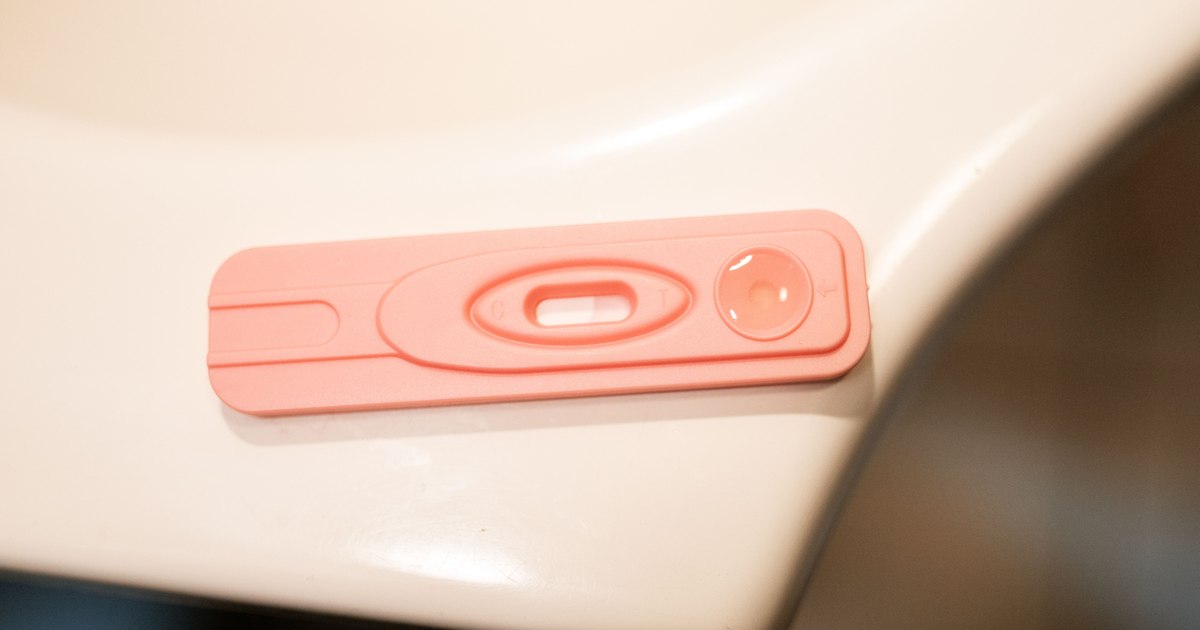
A faint line on a home pregnancy test usually means one of two things: an early, genuine positive, or an evaporation line left behind as the test dries. The timing of when you looked at the result and how the test behaves on repeat testing are what actually separate the two, not how dark or faint the line looks in the moment.
Why a line can be faint even when you're pregnant
Home pregnancy tests detect a hormone called hCG, which rises from a low starting point right after implantation. Very early in pregnancy, or if you've tested before your missed period, hCG may be present but still at a low concentration. A test line's darkness roughly reflects how much hormone is in the sample, so a faint line early on is often simply a true positive caught at a low hormone level, not a weak or unreliable result.
This is also why the same test taken a few days later, once hCG has had time to rise, typically shows a darker line. A genuine pregnancy's hCG level generally climbs quickly in early days, so lines from repeat testing tend to darken over that stretch rather than stay the same or fade.
What an evaporation line actually is
An evaporation line is a faint, usually colourless or grey line that can appear in the test window after the urine has dried, once the recommended reading time has passed. It isn't caused by hCG at all — it's a residue mark from the test chemistry drying out, and it can appear on a test regardless of whether you're actually pregnant.
This is exactly why every test has a stated reading window printed in its instructions. A line read within that window reflects the actual chemical reaction; a line that appears only after that window, once the test has sat out and dried, is far more likely to be an evaporation artefact.
Reading the test within its stated time window, and retesting a few days later if the result is unclear, tells you far more than staring harder at one faint line.
How to actually tell the difference
- Check when you read it. A line seen within the test's stated reading time is a real result. A line that shows up only after the test has dried out for longer than instructed is more likely an evaporation line
- Look at colour. A true positive line is typically the same colour as the control line (often pink or blue, depending on the brand). An evaporation line is usually colourless or grey
- Retest a few days later. If your period still hasn't arrived, a repeat test in 2 to 3 days will usually show a clearly darker line if you're genuinely pregnant, since hCG rises quickly in early pregnancy. A line that stays exactly as faint, or doesn't reappear at all, points away from a true positive
- Test first thing in the morning. Morning urine is more concentrated, which gives hCG the best chance of showing up clearly if it's present
Frequently asked
Can someone tell me if my test line is positive just from a description or photo?
Not reliably, and not safely. Reading a line's exact shade or thickness from a description or photo isn't the same as seeing the physical test within its correct time window, and it isn't a substitute for a proper test read in person. A home pregnancy test or blood test done again is the reliable way to know.
Does a faint line always mean I'm pregnant?
Not always, but a faint line within the correct reading time is usually a true positive at low hormone levels, most often because it was taken very early. A line appearing well after the test dried out is more likely an evaporation line rather than a true result.
How soon should I retest if my line looked faint?
Waiting 2 to 3 days and testing again, ideally with morning urine, is a reasonable approach. A genuine pregnancy's hCG usually rises enough in that time for the line to darken clearly.
Should I confirm a faint line with a blood test?
If you want certainty sooner than a home retest allows, or if your home tests keep giving unclear results, a blood test through your doctor measures the actual hCG level rather than relying on a visual line, and is the more definitive option.
Can medications or health conditions cause a false positive?
True false positives are uncommon but not impossible, and certain medications or medical conditions can occasionally affect a result. If your home test result doesn't match your symptoms or expectations, it's worth discussing with your doctor rather than relying on repeat home testing alone.